 Escambray ENGLISH EDITION
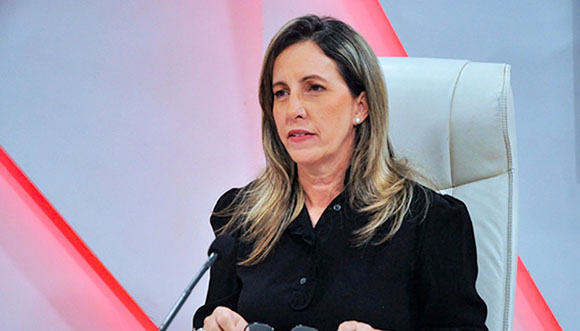
Both in literacy and before the ethical dilemmas imposed on us by artificial intelligence (AI), the most important thing is to have a humanist vision, to ask ourselves what we teach humanity to do with the development of any aspect of knowledge, affirmed Naima Ariatne Trujillo Barreto, Cuba’s Minister of Education.
In an interview with La Jornada, after participating in the summit to commemorate the 60th International Literacy Day of the United Nations Educational, Scientific and Cultural Organization (UNESCO), held on September 8 and 9 in San Cristóbal de Las Casas, Chiapas, she reflected on the battle that the use of AI and literacy impose on the world.
How are you going to face, for example, the battle of AI?
–It has a lot to do with the ethical dilemmas that humanity faces with every development. Now it is AI, but at other times it has been other things. That is why there is also a great debate in the country, as in the world, about how we can ensure that a citizenry that interprets itself from a humanist approach can use any development, including AI, for good.
“Moreover, we have a bit of a battle of AI with HI, with human intelligence, which is irreplaceable. But the most important thing is that we can foresee, within those ethical dilemmas, what things could crush human development and which are indispensable as part of what is generated by AI or any other technological development.
“We are facing an old dilemma that impacts us because of its speed, but we have had it before, as with the nuclear phenomenon. That is why I believe the most important thing is what we teach humanity to do with the development of any matter of knowledge.”
At this international meeting on literacy, there were two recurring themes, in addition to AI, in the concerns of countries: the community dimension and respect for multilingualism, for our cultures. How relevant are they?
—If there is no respect for the individual, for countries, for democracies, for the way they have existed, we cannot speak of education or literacy, because the first thing that the educational phenomenon has, as a social and human fact, is respect for the human being.
“What is at stake is learning from all cultures, but preserving and respecting our own. If that does not happen, we would not be talking about education, but about colonization.”
Beyond reading and writing
Trujillo Barreto also stresses that beyond the milestone achieved by Cuba, a country that managed to make its population literate with massive social participation of young people and adolescents through the Yo Sí Puedo program, we must continue advancing access to every human being’s right to education, and not limit ourselves to making sure they only know how to read and write.
For this reason, once the central advance against illiteracy was achieved, they developed the Yo Sí Puedo Seguir program to guarantee access to subsequent educational levels. Currently in her country, she said, education is universal, public, and free. “Any Cuban, if they wish, can pursue a second doctorate.”
Cuba achieved a historic feat by making its entire people literate in practically one year. What can you say to the world after demonstrating that this scourge can be ended?
–It is perfectly possible. At that time there was a great social and community mobilization of all actors. I believe that can be a great solution; we would even get our young people to take on essential things, such as teaching others.
“Although making it sustainable is difficult because there are many different realities, some of which are imposed on us and in other cases must be defended, it is sustainable and it is possible, even to surpass it, because after literacy, Cuba had a battle for sixth grade, for ninth, for twelfth grade, for university.
“Now we have a very difficult reality. We are reinventing multiple forms of access (to education) to see how we can ensure that this principle of equity and justice that we have achieved can be maintained under a very complex condition that has been imposed on us. We know how to do it better than we are doing it, only that there are also realities in which today we have great battles.”
Take from La Jornada


Escambray reserves the right to publish comments.