 Escambray ENGLISH EDITION
“Let us review each discipline, each human and material resource we dedicate to sport. We must be profound in our analyses, apply new ideas, concepts and knowledge.”
Those words by Commander in Chief Fidel Castro Ruz, on August 24, 2008, in his reflection “For the honor of a gold medal,” at the end of the Beijing Olympics that year, were like a catalyst for renewing the thinking of the Cuban sports system.
But today, in the year of his centenary, they must not only be evoked but also materialized. If we look for an antecedent of the Cuban Sports Research Center (CIDC), which celebrates its tenth anniversary this Monday, that exhortation is inscribed in its foundational essence.
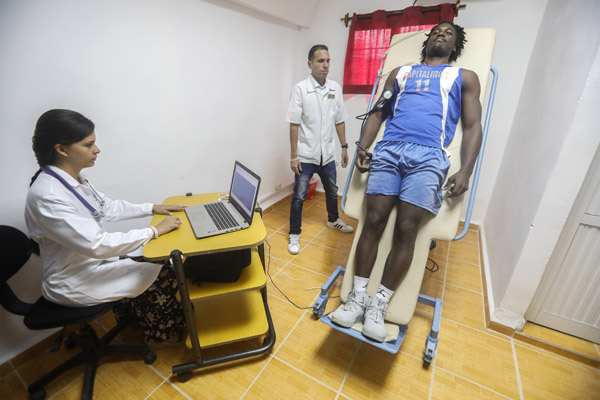
So believes Dr. Alfredo Quintana Díaz, director of that institution, who told JIT that “in its beginnings the CIDC had a focus on biomedical tests, although always with the objective of becoming the house from which science would become the support of Cuban sport.”
Ten years later, that foundation of its mandate is already seen as a necessity by coaches and technical teams of several sports, “even though we believe it should still be used more with a view to improving performance and, consequently, sports results,” he stated.
Quintana specified that the CIDC’s scope goes far beyond high competition. “As part of the holistic prism that guides us, we have given it a social orientation, toward the community, with the project of the Observatory of Public Policies on Physical Activity, Physical Education, Sport and Recreation.”
He explained that the aim is to achieve a physical-motor characterization of the school population for possible talent. “For example, teachers at the base of the high-performance pyramid, in the school sports initiation schools (EIDE), have pointed out that students arrive with many coordination problems that hinder the learning process. This observatory seeks information and, by characterizing that universe, contributes to solving the problems.”
He clarified that, like every process in the country’s current situation, this has been affected by transportation problems and others. “But we could not, nor can we, wait for there to be no difficulties to have a tool that guides talent and its coaches.”
However, he told us that they have already been in municipalities such as Guanes in Pinar del Río and Fomento in Sancti Spíritus. “There we left 15 tests to evaluate physical-motor activity, in pursuit of the ambitious objective of characterizing the school scenario. No one is going to change the evaluative parameters of Physical Education; we are going to deliver data and revolutionize this with the appropriate decision.”
So the CIDC is not only dedicated to studying the opponent, nor is the concept of Sports Intelligence limited solely to that aspect?
Of course it is much more; even the cornerstone of Sports Intelligence passes through one of the Center’s most important missions: making science so that the subject (athlete and coach) has the tools to find the best answers, both in training and before a changing or sudden situation in competition.
Of course Quintana did not deny scouting the opponent, “what happens is that we must know how to evaluate ourselves, know how we are faster or stronger; find, based on our potential and knowledge of it, a proposal the opponent does not expect, or that multiplies the athlete’s qualities. Studying ourselves internally is the key to sports intelligence,” he assessed.
And how do we advance in that wonderful and enigmatic world?
We are committed to achieving our situation room; it is indispensable for progress in that field. Through it would pass all our biomedical measurements, those from the neuroscience laboratory, those we do in the field, and the biomechanical ones. That is, an accumulation of information that, when processed, allows early alerts at any stage of fitness. That data would connect Sports Intelligence with another concept, Strategic Intelligence. It means we know how to be better, but we can design how to achieve it.
That is why the situation room is so important. Having it gives us great strength in studying our athletes and teams to seek and reach, with the information we obtain from the opponent, success.
That room, with the results it presents, will further promote the link between decision-makers and the CIDC and between the CIDC and them, in a strategy aimed at ensuring that the subject, whether coach or athlete, is not only an object of research but also a protagonist of the research act, from knowledge of the study and of their own strengths.
The CIDC director commented that there are many such institutions in the world that become strong in certain specialties, with the aim of having a broad market. In the Cuban case, its holistic approach covers a more social view and integrates several edges, from the community to high performance.
From that integrality its workforce is also nourished, today 60 workers, “of them 33 researchers, among whom eight doctors of science and the same number of master’s degree holders stand out. For us the tenth anniversary year has been very important, because we managed to categorize 11 researchers, a figure never before reached,” noted the CIDC director.
He added that the specialists come mostly from the University of Sport, the Institute of Sports Medicine, which with its medical triad is at the forefront of the athlete’s optimal form, and from several distinguished coaches. Precisely from that last area comes Quintana Díaz, as well as distinguished coaches of national teams such as Gilberto Herrera, in volleyball, and Armando Padrón, in judo.
Also from those lines were the first director, René Romero, an institution in sports training, and Pavel Pino, an excellent doctor.
He highlighted in these ten years milestones such as the strike zone for baseball, by young researcher Alfredo Ríos, which contributes to characterizing the player; that of the public policies observatory itself; and the one achieved in the study prior to the Tokyo 2020 Olympics, especially with boxing, wrestling and canoeing, which made possible an outstanding performance at that event.
He argued that the CIDC, even in the complex situations the country is going through, can contribute decisively to sports results. He assured that it has the possibilities and prepared human resources to recover the punch of Cuban boxers, make canoeist Yarisleidis Cirilo even more powerful, and study how to multiply the attributes of the main exponents of athletics.
If the science and innovation program is a pillar of Government management, the Cuban Sports Research Center must be the mainstay of the management of the Cuban sports system.




Escambray reserves the right to publish comments.